

We often obsess over Product Management methodologies to ensure our software survives the market. We identify pain points, prioritize backlogs, and measure with religious fervor. But when it comes to leadership, we often revert to “vibes” or intuition.
The most effective leaders don’t manage individuals; they lead the environment. By applying a Product Management lens to your leadership, what I refer to as Cross-Pollination, you shift from reactive oversight to intentional design. This ‘why’ is simple: it transforms your role from a bottleneck into an architect, enabling your team to operate as a scalable, high-performing platform where success is built into the system.
From Product Manager to Leadership Architect
To understand this mindset shift, we must look at the direct relationship between managing a software product and leading a human team. In both ecosystems, your success is defined by how effectively you design an environment that empowers its participants.
Mapping the Leadership Ecosystem
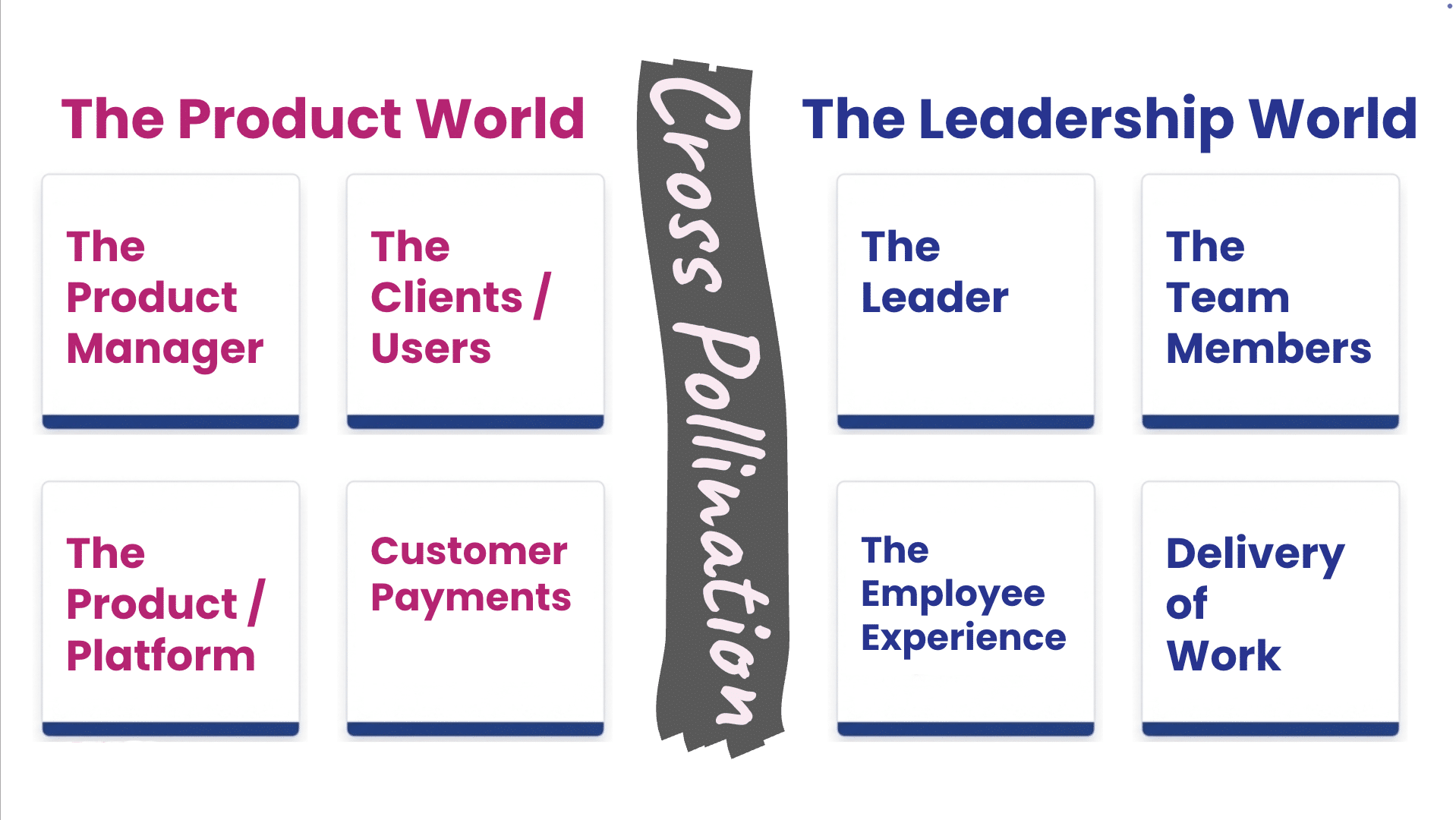
When you view leadership through a Product Management lens, the components of your daily work become much more intentional:
- The “User” is your Team: Just as a PdM obsesses over customer needs, a leader must obsess over the needs, blockers, and friction points of their people.
- The “Product” is the Team Environment: You aren’t “managing people”; you are designing the “platform” (the processes, culture, and tools) they interact with every day.
- The “Service” is your Leadership: Your role is to provide the architectural support that makes high performance the path of least resistance. You are the enabler, not the bottleneck.
- The “Value Exchange”: In a product model, customers pay with money. In this leadership model, your team “pays” the organization with high-quality output, engagement, and reliable delivery.
The 4-Stage Leadership Cycle
Just as a product evolves through iterations, leadership should follow a continuous four-step loop: Identify, Prioritize, Test, and Measure.

1. Identify: Validating Needs and Opportunities
A Product Manager wouldn’t invest resources into a new direction based on a hunch; they use discovery to validate where the value lies. As a leader, you must apply that same rigor. This isn’t just about “fixing what’s broken.” It’s also about identifying what is working well so you can amplify it and uncover hidden opportunities for growth.
While the specific discovery methods will vary depending on your team’s maturity, here are a few examples of diagnostic entry points: (knowing that your full toolkit can be much broader):
- Discovery 1-on-1s: Deep-dive sessions to uncover systemic blockers, to identify “moments of high engagement.” What tasks make them lose track of time? What parts of the culture do they want to protect?
- Shadowing & Observation: Spending time “in the trenches” to see where things break and to witness organic collaboration. You might discover a “secret” workaround or a communication style that is highly effective and should be standardized.
- Team Health Metrics: Analyzing data to find both the friction points and the “peak performance” windows. Understanding why a project went exceptionally well is just as valuable as understanding why one failed.
The goal is to ensure you build a roadmap grounded in validated reality, allowing you to eliminate the “bugs” in the environment while scaling the “features” your team loves.
2. Prioritize: Ordering the Leadership Backlog
You cannot fix everything at once. Just as a PdM sequences a roadmap, a leader must decide which opportunities will move the needle most. This is where you move from being a “reactive manager” to an “intentional architect.”
While there are dozens of frameworks to help you rank your backlog, here are a few ways to filter the noise:
To build a professional roadmap, we use three distinct lenses to filter our backlog:
- A quantitative lens (i.e., Team Pulse Surveys): This is your market data. It allows the team to “drive” the priority by identifying which issues are most widespread. It ensures you aren’t solving a “niche bug” when you have a “system-wide crash.”
- A qualitative lens (i.e., the Eisenhower Matrix): This is your leadership craft. You use your strategic knowledge to categorize needs based on Urgency vs. Importance. It allows you to protect the long-term, high-impact work that often gets buried by daily fires.
- The “pruning” lens (Cost of Inaction): This is your final stress test. You ask: “What is the specific price we pay if we do nothing about this right now?” This helps you discard the “nice-to-haves” and focus only on initiatives where delays create real organizational debt.
3. Ideate & Test: The “IKEA” Effect in Leadership
In traditional Product Management, a PdM doesn’t just lock themselves in a room and emerge with a finished feature; they collaborate with engineers and designers to find the best solution.
As a leader, your “Target Audience” for this stage is your internal team. If you define and execute every change yourself, your team becomes passive users of your rules. Instead, we aim for Co-Creation.
In psychology, this is known as the “IKEA Effect”— the phenomenon where people value a product more if they had a hand in building it. When your team authors the solution to a friction point, they move from being “employees following orders” to “architects of their own progress.”

How to facilitate Co-Creation
There are dozens of ways to bring your team into the “design room.” The specific tool matters less than the principle: The leader owns the “Why” (the problem/opportunity), but the team shapes the “How” (the solution).
Depending on the scale of the change, you might use examples of methods like:
- Collaborative Brainstorming: Hosting a session where the team ideates on a new communication protocol, rather than you just sending a new policy.
- Pilot Programs (The MVP): Treating a new process like a “Beta version” for a few weeks. This creates a safe space to gather feedback and iterate before a full rollout.
- Retrospectives: Reclaiming the “Retro” as a design space. Instead of just listing what went wrong, the team works together to architect the improvement.
When the team helps design the environment, accountability is built in. They are no longer just “executing” your change; they are responsible for their own ideas. They own the architecture, so they are naturally invested in making sure it succeeds. They become the artists of their own progress.
4. Measure: The Iteration Loop
A change that isn’t measured is just a guess. In the PdM world, we look for signals of product health; in leadership, we look for signals of environment health. This is where we decide: Do we double down, pivot, or roll back?
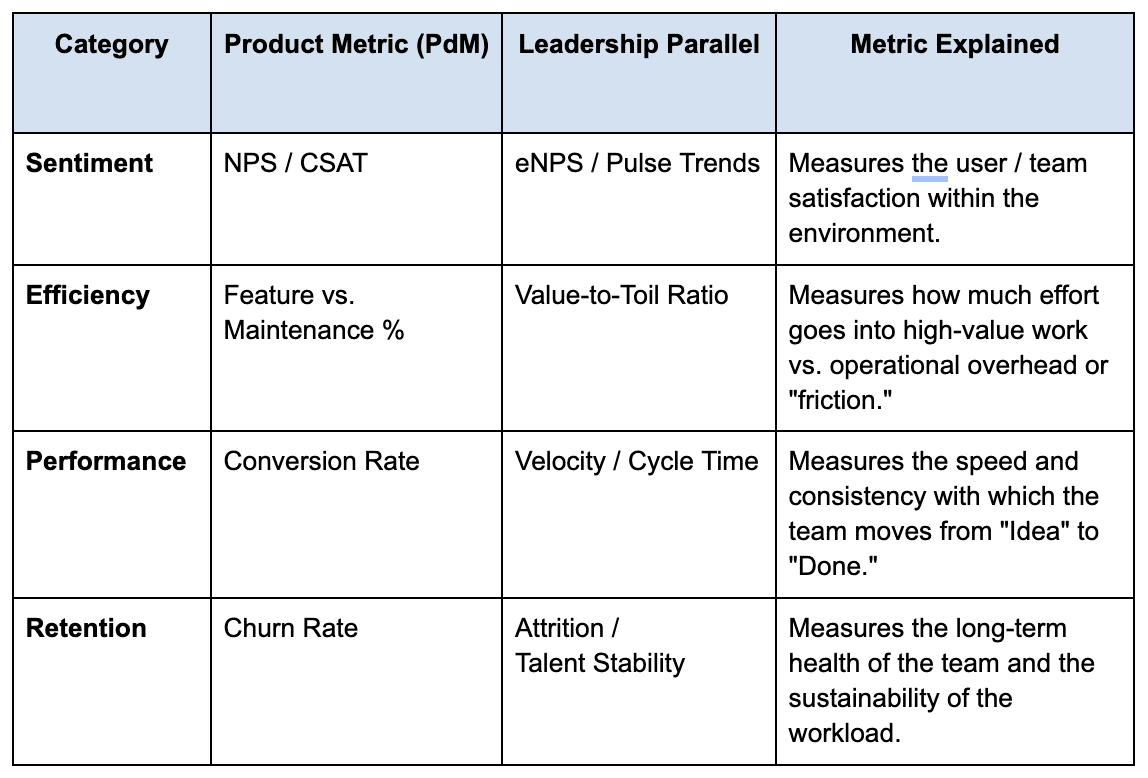
Measuring Success (PdM vs. Leader)
To professionalize your leadership, you need to track parallels to standard product metrics. While every team is different, here is how some metrics translate:
The “MVP” Mindset: Launch, Listen, and Pivot
The most important part of measuring isn’t the data itself; it’s what you do with it. This is a Continuous Feedback Loop:
- Release the “MVP”: You rolled out a small change (the pilot/beta from the previous step).
- Gather Telemetry: You check your metrics. Is velocity up? Is the “Pulse” score on frustration down?
- Iterate: If the “feature” (the new process) is working, you scale it to the whole team. If it’s creating more friction, you roll it back or tweak the architecture.
By treating your leadership decisions as iterations rather than “permanent rules,” you lower the stakes. It allows you to be a leader who reacts to data, not just to the loudest voice in the room. If a change doesn’t move the needle, don’t take it personally. You just started the next cycle.

Your Leadership Product
Professionalizing your leadership isn’t about working harder; it’s about designing better. By applying a PdM lens to your team, the formula for high performance becomes clear:
- The User: Your team members (whose pain points and “moments of flow” you must validate).
- The Product: The environment, processes, and culture of the team—the “platform” on which they work.
- The Value Exchange: In return for a frictionless, high-performing environment, the team delivers high-quality work, engagement, and reliable output.
By treating your leadership structure as an evolving product rather than a set of rigid rules, you move away from being a reactive “manager” and toward being an architect of success. You stop guessing, you start measuring, and you build a culture where performance isn’t forced, it’s designed.