


Salesforce Commerce Cloud was a defensible choice a decade ago. It isn’t anymore. Salesforce has stopped reporting commerce as a standalone line. The storefront architecture has been rebuilt four times in eight years. And the cost of staying keeps compounding due to contract escalation, technical debt, and a talent pool that gets smaller and pricier every year.
The key question isn’t whether to leave. It’s which Salesforce Commerce Cloud alternative you replace it with, and whether you can defend that call after you’ve made it.
If you’re the one who has to walk that decision into a budget conversation, you already know sales talk doesn’t survive contact with your leadership team. If you’re the one who has to sign off on the technical case, you’ve heard enough vendor pitches with no substance behind them. Both of you need a framework that would hold up against any platform, not just the one being pitched to you.
The Five Criteria
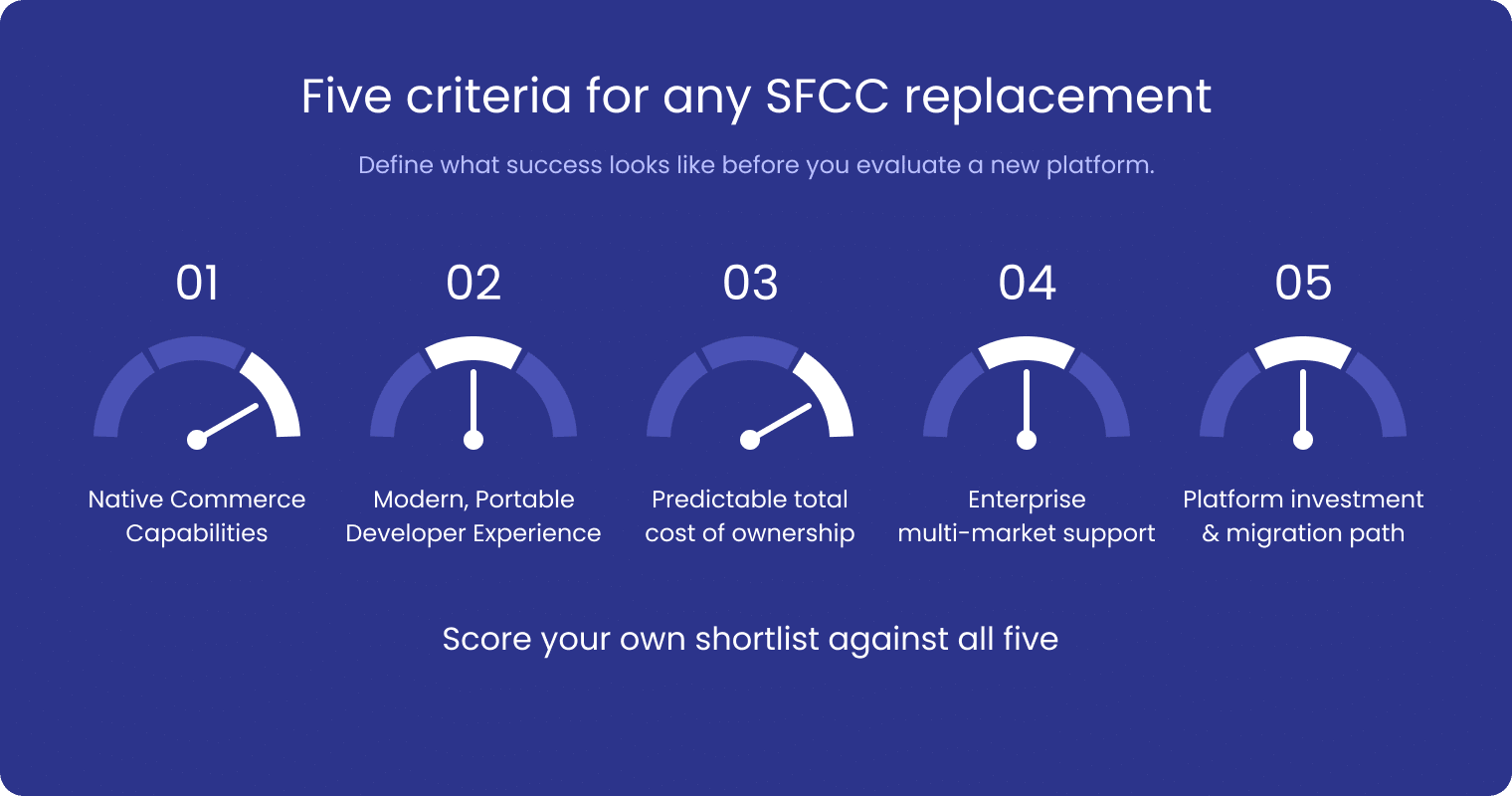
Here are the five criteria we use to evaluate any SFCC replacement. Score your own shortlist against them before you read another vendor deck.
- Native commerce capabilities. How much of the commerce core, product information management, order management, checkout, promotions, and search, does the platform provide natively instead of through assembled integrations? Each system folded in is one less contract, one less integration, and one less place where two systems can disagree about the same order.
- Modern, portable developer experience. Can you staff and sustain the team from the standard web-developer pool instead of a scarce, expensive specialist one? Can your developers build and test locally, and can you pull your own product, customer, and order data out through open APIs whenever you need to?
- Predictable total cost of ownership. Can you calculate a three-year total cost of ownership from a single document? Core capabilities should be included, not billed as add-ons, with support, hosting, security, and updates already in the base fee.
- Enterprise multi-market support. Multi-market, multi-language, and multi-currency operation is table stakes at this scale. The differentiator is cost. How much of each new market is native configuration versus a custom build?
- Platform investment and a proven migration path. Is commerce the vendor’s core business or a side bet? Is the platform proven at enterprise scale? And can the delivery partner show a repeatable, documented method for actually getting you out of SFCC, not just into the new platform?
We hold SCAYLE to these same five criteria in the full paper. One migration built on this framework saw a 60% rise in profitability within two months of launch. Download the paper for:
- Where SCAYLE meets the bar and where it doesn’t.
- The real cost breakdown of license, integrations, system-integrator retainers, and what a migration actually recovers.
- A six-phase migration framework built from a dozen-plus enterprise platform exits, staged so no single event carries the business.
- The four numbers to put on paper before you commit to any platform.