


As a millennial who grew up on a healthy diet of Mythbusters, I heard that Ring cameras rolled out a new AI update and was curious about its accuracy. This seemed like a perfect AI test: The Ring camera was good at identifying humans and squirrels in the yard, but could it identify a human dressed as a squirrel in your yard?
It got close.

So, why did I dress up like a squirrel?
Amazon’s Ring update felt like the perfect example of many AI products: It looks mind-blowingly magical at first (i.e., “A USPS Driver is Approaching Your Door.”), but struggles when things deviate from the norm (i.e., “a gray dog” that is actually a man dressed in a squirrel costume).
So, AI Isn’t Real?
It’s not that AI isn’t real; it’s that AI is new. And in any emerging market, it can be hard to know which promises are real and reliable, and which are built on hopes and ambition. Companies with an AI vision anchored in a realistic plan will be the winners.
Amazon’s Ring camera actually did a decent job: It alerted to a “Notable Activity at Garage.” I think we can agree that a man-squirrel creature in your backyard is notable. It failed at identifying what the “activity” was.
If your business relied on identifying USPS, UPS, and FedEx delivery drivers, as Amazon’s business does, the Ring camera succeeded. If your business relies on correctly identifying people or animals, such as security companies, it does not. This is the AI takeaway: your business doesn’t have a realistic AI strategy unless it includes challenges and AI success metrics.
What Makes A Good AI Strategy?
Technology is not a strategy. Home builders don’t talk about hammers when asked about their company’s future. You will need technical designs with architectures and integrations, but before you get there, you need to identify:
- Organizational risk tolerance.
- How your business includes security, compliance, and governance.
- Defined and measurable business challenges that you want to improve.
- Your organization’s data requirements.
- A budget, with expected returns and outcomes.
It is only when you know what you are doing that you can define how you will do it by:
- Mitigating AI risks and mistakes.
- Defining measurable metrics for success or failure.
- Identifying data and data integrity.
- Designing technical solutions with architecture and integrations.
- Creating a Plan B, and maybe even a Plan C.
Not a single bullet point above states that every organization needs to buy a tool or adopt a technology to be successful. To achieve AI success, you have to figure out what makes AI successful for your organization. Success isn’t achieved through procurement; success is achieved by organizations defining and executing an AI roadmap.
I am hearing a lot of vague statements from company leaders that boil down to, “I need to do something with AI.” They are right; every organization should be dipping its toe in the agentic pool. These ambiguous statements stem from leaders feeling pressure to keep their organization moving, but not knowing where to go.
Just buying a product (e.g., Chatbot) or signing off on an ambitious project for a digital cure-all isn’t the answer. We have a word for someone who helps you find the right path on a journey: a guide. A good guide is a partner with hands-on experience working with AI, and who prioritizes your success over products.
Companies that took the “leap before you look” AI approach are already feeling the knock-on effects. As we saw with the squirrel costume, AI struggles as soon as things get weird (i.e., different). The businesses that rushed to replace humans with AI for customer service are seeing service failures 4x higher.
That doesn’t mean AI should be abandoned; it means companies didn’t set the right expectations and metrics. AI is still evolving, and when things deviate from the norm, it can get close to right (i.e., “a gray dog”). But the saying isn’t “Close only counts in horseshoes, hand grenades, and good customer service.” A good AI strategy is one that progressively builds on real objectives, using a technology that improves rapidly.
Am I Ready for AI?
Yes, you are ready for AI. But AI is a big, ambiguous word that can mean a lot of things. It is like asking, “Am I ready to drive?” That could mean a sedan, an SUV, a Mack truck, or a Formula 1 race car.
Most people jump in by purchasing a vendor’s tool and hoping their sales pitch comes true based on the vendor-provided metrics. That is how we get an MIT report stating 95% of organizations see 0% ROI on AI, released at the same time as Google’s report stating that 74% report ROI within the first year.
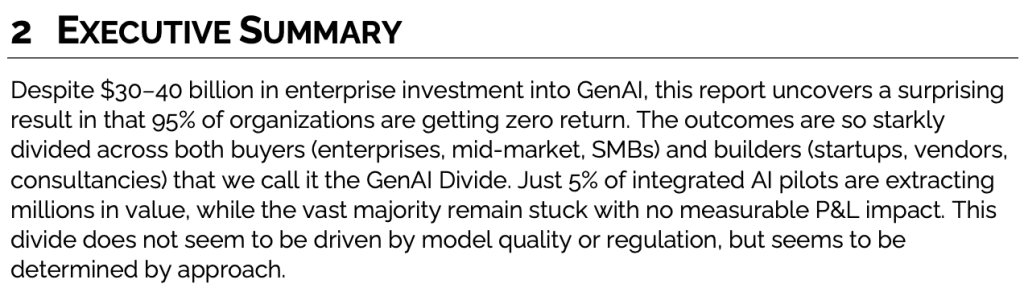

It’s hard to say something is successful if you aren’t sure what you are solving, what the successful outcome is, and how you are going to measure it. Aries can help you be ready.
So, We Learned Something from the Squirrel Costume?
The worst but funniest outcome would have been if the Ring camera said, “Yeah, that is for sure a squirrel.” The best, albeit less entertaining outcome, is if the Ring camera had said, “That is a person dressed in a squirrel costume.” I think “Notable Activity: it’s a gray dog” is a pretty good outcome.
This whole squirrel chicanery was a fun weekend activity inspired by someone who watched too much Mythbusters on TV growing up. However, it shows that AI isn’t magic that solves all problems. You need to have a plan, realistic goals and expectations, and measurable success. A Ring camera is great at identifying delivery drivers and general activity around your house. If you have a giant squirrel problem, you might want to consider a dog.
Note: Since writing this article, Amazon has released an ad during the Super Bowl featuring the Search Party feature, which uses Ring cameras to help find lost dogs. Be careful, or you may end up finding a grown man in a squirrel costume instead.